The primary document
A National Call to Action to University Presidents and Governing Boards
U.S. Department of Education · signed by Linda E. McMahon, Secretary of Education · August 3, 2026
Publish a statement, prominently, on your own website describing your commitments to rigorous teaching, pathbreaking research, and national service, answering seven specific questions and detailing adopted and planned reforms.
Asked of
Every postsecondary institution in the United States
Due
December 31, 2026
Enforcement
None. No funding or penalty attached.
Read the PDF (3 pages, the letter as issued). Also available on ed.gov.
The document this project is built around. The letter as the department issued it, mirrored here so it survives a URL change. It is a U.S. government work and is not subject to copyright.
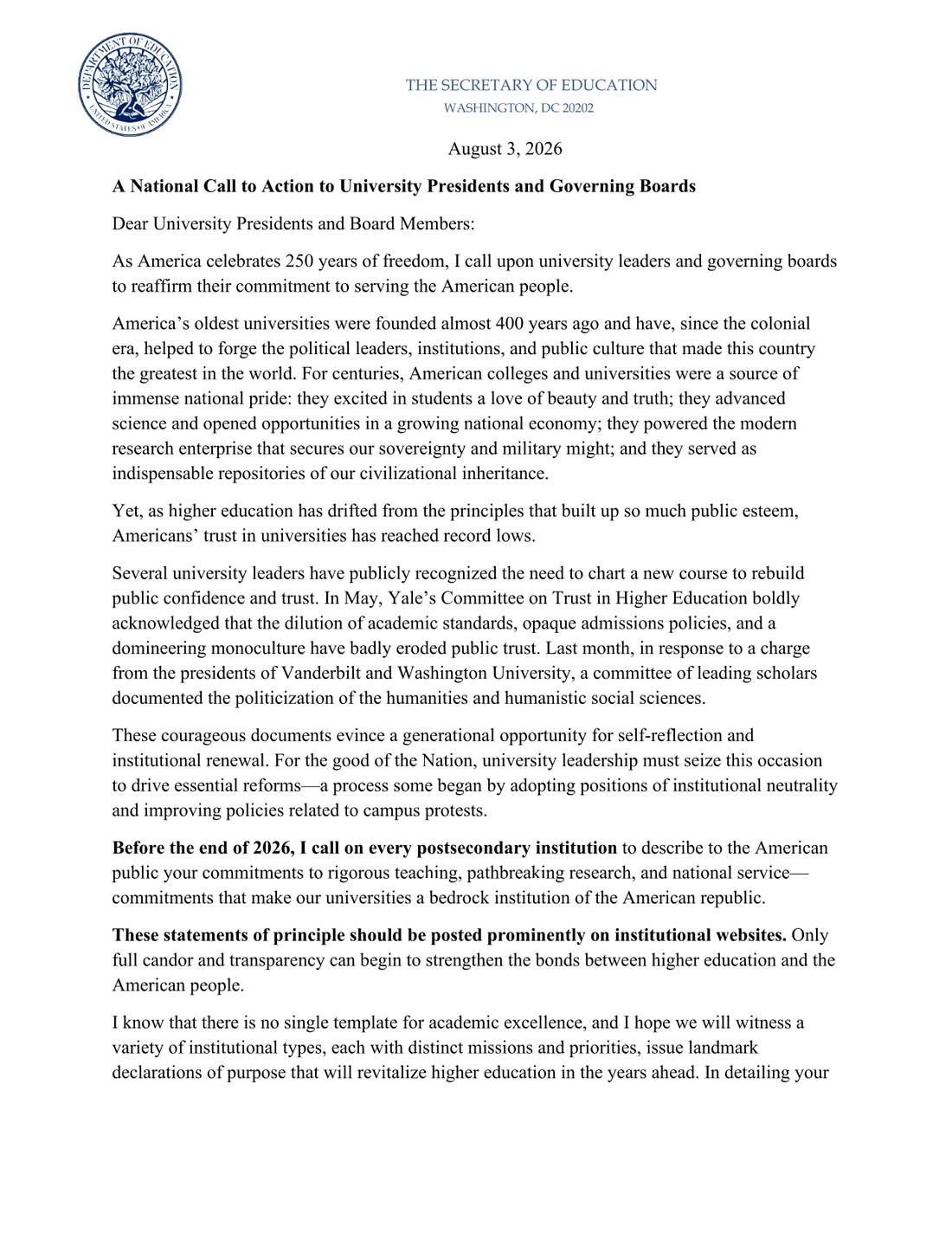 Page 1 of 3. Open the full letter as the department issued it.
The 7 questions
Each institution is asked to answer these publicly, detailing adopted and planned reforms. The ask is quoted from the document; the reasoning below it summarizes the argument the department makes for asking.
- 01
Admissions transparency
AdmissionsHow will your institution ensure that admissions criteria are transparent and wholly described to prospective applicants? And how will your institution ensure admissions decisions are based on merit, achievement, and your university's educational purpose?
The reasoning given: The department argues that opacity in admissions has driven allegations of favoritism and illegal discrimination, and that accusations of evading Students for Fair Admissions v. Harvard will persist while criteria stay hidden.
- 02
Free speech and protest
SpeechHow will your institution protect the free exchange of ideas, wide-ranging debate, and open-minded campus discourse? And how will you guarantee that unruly and violent protestors do not harass students or disrupt classes, research, public lectures, and campus operations?
The reasoning given: The department frames the collision of opposing viewpoints as necessary to advance learning and prepare students for the duties of citizenship.
- 03
Intellectual pluralism and faculty hiring
FacultyHow will your institution encourage intellectual pluralism in all its academic units? How will your faculty hiring and evaluation practices support academic vitality and ensure that all relevant perspectives are taken seriously?
The reasoning given: The department cites a recent Report on the State of Scholarship in the Humanities and the Humanistic Social Sciences, arguing that ideologically skewed disciplines damage the truth-seeking function of the university.
- 04
Cost and student outcomes
CostHow will your institution ensure that families can access affordable, high-return degrees? What can your school do to contain costs, improve pricing transparency, and ensure that every academic program equips students to repay their loans?
The reasoning given: The department attributes rising prices in significant measure to administrative costs unrelated to core university functions, and points to attrition and loan-default rates.
- 05
Rigor in the age of AI
StandardsHow will your institution incentivize rigor in the age of AI, combat grade inflation, and prioritize excellence in teaching and learning?
The reasoning given: The department argues artificial intelligence has upended traditional methods of teaching and assessing student learning, and notes that some schools have already announced steps against grade inflation.
- 06
Foreign influence on research
ResearchHow will your school protect academic programs from foreign influence and safeguard the integrity of the research enterprise?
The reasoning given: The department asks institutions to refuse gifts with problematic conditions and to keep malign foreign actors away from sensitive research, personnel decisions, and admissions.
- 07
National service and workforce
National interestHow will your institution answer this national call to action? How can your campus and faculty advance American security interests, deliver academic programs that meet urgent workforce needs, and contribute materially to the Nation's prosperity?
The reasoning given: The department frames the ask around the hundreds of billions of taxpayer dollars invested in higher education each year, and asks institutions to put American students, faculty, and interests first.
How this differs from last year's compact
Compact for Excellence in Higher Education (2025)
The earlier compact offered preferential federal funding to universities that agreed to specific policies such as freezing tuition and limiting international enrollment. The 2026 call to action attaches no funding and asks only for a published statement.
That difference is the whole argument about this document. Supporters read a non-binding request for transparency. Critics read the same agenda as the funding-linked compact, arriving without the leverage that made the first one contestable.